
Event rental companies get recommended by ChatGPT and Google's AI answers when they already sit on the shortlist the assistant has learned from the open web. That shortlist is built from a consistent identity and repeated proof of real work, not from page speed or schema alone.
The shortlist forms before a planner asks
When a planner asks an AI assistant who to rent from, the assistant answers in one of two ways. It can answer from what it already knows: a pre-formed list, built over time from directories, reviews, press, social profiles and mentions next to established names. Or it can run a live web search at answer time. The first path is much stronger. If the model already has you on its list, it names you without having to go looking.
A company not on that pre-formed list does not get the call. Simple.
A real test in Nashville
In September 2026, we asked ChatGPT the same question in several fresh sessions: "What is the best AV rental company in Nashville?" Nashville Visual, an established AV rental company, was not named in any of them.
A stable answer across repeated runs means the model is confident. It has a clear shortlist, and that shortlist did not include a long-running company with real work all over town. That is the problem in one sentence.
The assistants do not decide who is good. They decide who already looks chosen.
What actually puts you on the shortlist
- A consistent identity everywhere: same name, phone, address and owner on your site, Google Business Profile, directories and social profiles.
- Content that answers the questions planners ask, by event type and by venue.
- Proof of real work at real venues, with photos and write-ups.
- Reviews on the platforms planners already check.
- Mentions alongside the names that already show up.
- Measuring every week with the same buyer questions instead of guessing.
Consistency matters because AI assistants see the same company name across different sources as one stronger signal. Conflicting details read as noise. When the same name, address and owner appear over and over, the assistant treats the company as established.
Technical fixes alone will not do it
Page speed, schema and llms.txt help the search path. They do not by themselves put you on the pre-formed shortlist. Search means the assistant has to go find you. Being on the shortlist means it already knows you. One is fishing. The other is being on the shelf.
How to prove real work at real venues
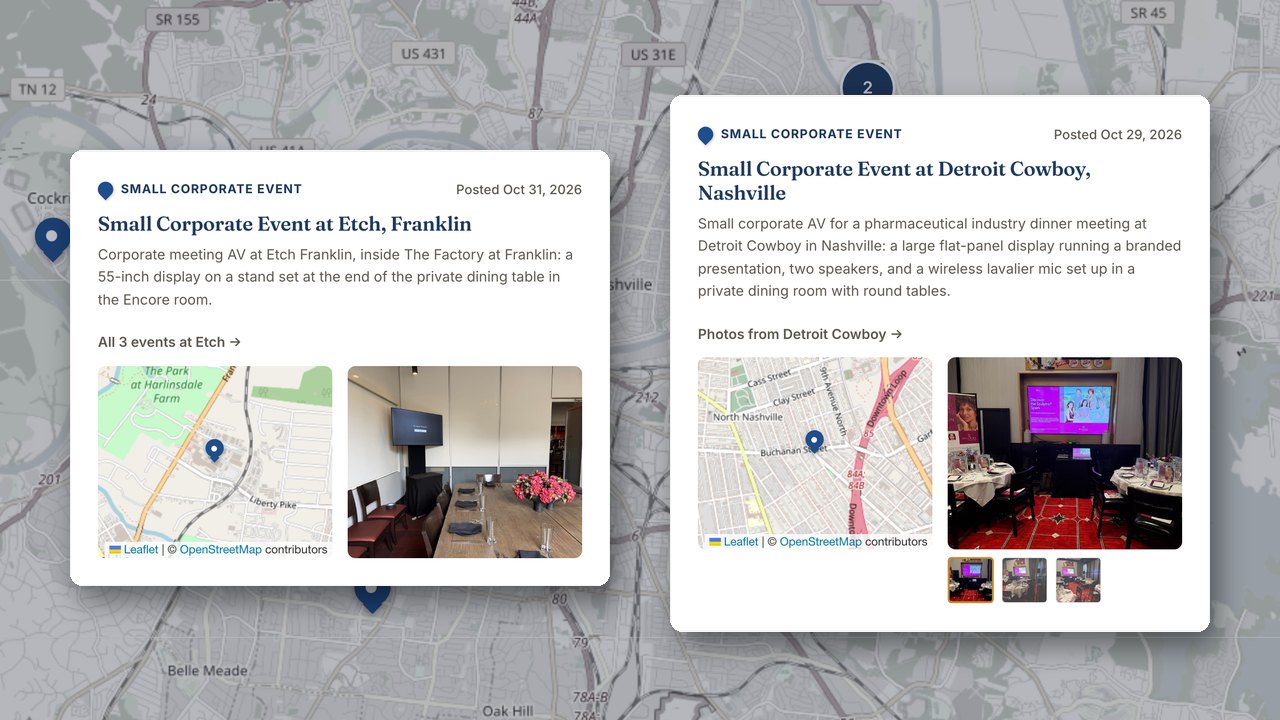
This is where GeoPins come in. After a gig, the photos become a pin on a map at the real venue, with a short write-up. Each venue gets its own page that collects every event the company has worked there. Rules: name the venue and event type, not the client. Post date is the publish date, never a fake event date. Real photos only.
Why this works: planners search by venue. "AV at the convention center" or "tent rental at the estate venue" are real queries. A venue page proves you have loaded in there. Search engines and AI assistants see real work tied to real places. Every gig you already do becomes marketing without a photographer or an agency.
GeoPins is part of the platform and is live on nashvillevisual.com today.
Measure weekly with the same questions
One thing we do at AmpLive is track the same buyer questions every week across ChatGPT, Claude and Gemini. We call it the AI Visibility report. It shows who gets named, and more important, whether you are moving.
Nashville Visual is the first company running on AmpLive. Ginny checks its buyer questions every week, and since launch the trend has been moving in the right direction.
Early weeks. We say that honestly because a few weeks is not a track record. It is a direction. The direction matters because it comes from doing the work consistently. You can see the full Nashville Visual story.
Where back-office software fits
Owners ask if this replaces their rental software. No. Goodshuffle Pro, TapGoods, Booqable and Rentman are good at inventory, quotes, contracts and payments. They are not visibility engines. None of them builds your content, tracks whether AI assistants name you, or maps your work to venues.
If your problem is double-booked gear, a back-office tool solves a real problem. But if the phone does not ring, inventory software will not make it ring. Two different jobs.
What to do this week
You can start without any new software. Pick five buyer questions you want to be named for. Ask them in ChatGPT, Claude and Gemini in fresh sessions. Write down who gets named. If your company is not on the list, that is your baseline. Then fix the consistency across your Google Business Profile, website, directories and social profiles. That step costs nothing but time, and it is the base everything else builds on.
If you want to see where your company shows up today, book a demo. We will walk through the same questions in your market, your category and your venues.