Goodshuffle Pro, TapGoods, Booqable and Rentman are back-office tools for event rental companies. They handle inventory, quotes, contracts and operations well. They do not get your company found by Google, planners or AI assistants. If you are double-booked on a busy Saturday, they solve a real problem. If nobody is calling, they will not change that.
The tools, in plain terms
Each tool has a different shape. Here is a fair summary of what each one does, and what it does not do.
- Goodshuffle Pro: rental-native back office for inventory, quotes, e-signature and payments. It syncs invoices and payments to QuickBooks Online. Its marketing is mostly a website inventory widget. Good for party rental and event rental companies that need contracts and inventory control.
- TapGoods: inventory and operations for rental companies. Its focus is running the stock and the jobs. It is not built to make you visible in Google or AI answers.
- Booqable: an online rental storefront. It focuses on letting customers check availability and book rentals from your website. It helps customers book, but it does not build your overall web presence or tell planners why they should trust you.
- Rentman: built around crews and gear for AV and production work. It is strong for the back office of an AV company. It does not produce venue pages, editorial content or visibility tracking.
Also in the rental software world: InflatableOffice, Current RMS and Point of Rental. Each solves a version of the same back-office problem. They are good at it. None of them is a visibility engine.
Back-office software keeps the doors open. A visibility engine makes the phone ring.
What these tools are good at
All of these tools do the same core job: they stop the back office from becoming a pile of double-booked gear and lost invoices. That is a real problem. If your calendar is wrong, your crew shows up at the wrong venue, or your invoices do not go out, a rental back-office tool is worth it. Goodshuffle Pro does not replace QuickBooks. It pushes invoices and payments into QuickBooks Online. That is an honest, useful function.
But owners run two businesses at once. One business is operations: the gear, the crews, the deliveries, the payments. The other business is demand: the planner who needs to find you, the venue that recommends you, the AI assistant that lists you or leaves you out. Back-office software only serves the first business.
The missing half
Planners and buyers are changing how they find rental companies. They ask ChatGPT, Claude, Gemini and Google's AI answers who to rent from. The assistant gives a short list of names. If you are not on that list, you do not get the call.
AI assistants answer in two ways. One way is from what the model already knows, the shortlist that forms over time from the open web. The other way is from live web search at answer time. Being on the pre-formed shortlist is much stronger than only being reachable by search. That shortlist is built from third-party association: reviews, directories, press and mentions alongside the established names, repeated across the web.
In a real test in September 2026, we asked ChatGPT a simple question in several fresh sessions: "What is the best AV rental company in Nashville?" Nashville Visual, an established AV rental company, was not named. Every run, an answer without it. That is not bad luck. The model has a settled picture of who to recommend, and Nashville Visual was not in it.
Technical fixes help the search path. Page speed, schema markup and an llms.txt file can make your site easier to crawl. They do not by themselves put you on the shortlist.
To get there, you need a consistent identity everywhere: same name, same phone, same address, same owner on your site, Google Business Profile, directories and social. You need content that answers the questions planners ask by event type and by venue. You need proof of real work at real venues. You need reviews and mentions alongside the names that already show up.
Rental back-office tools do none of that. Goodshuffle Pro, TapGoods, Booqable and Rentman do not build your content, do not track whether AI assistants name you, and do not map your work to venues. That is the missing half.
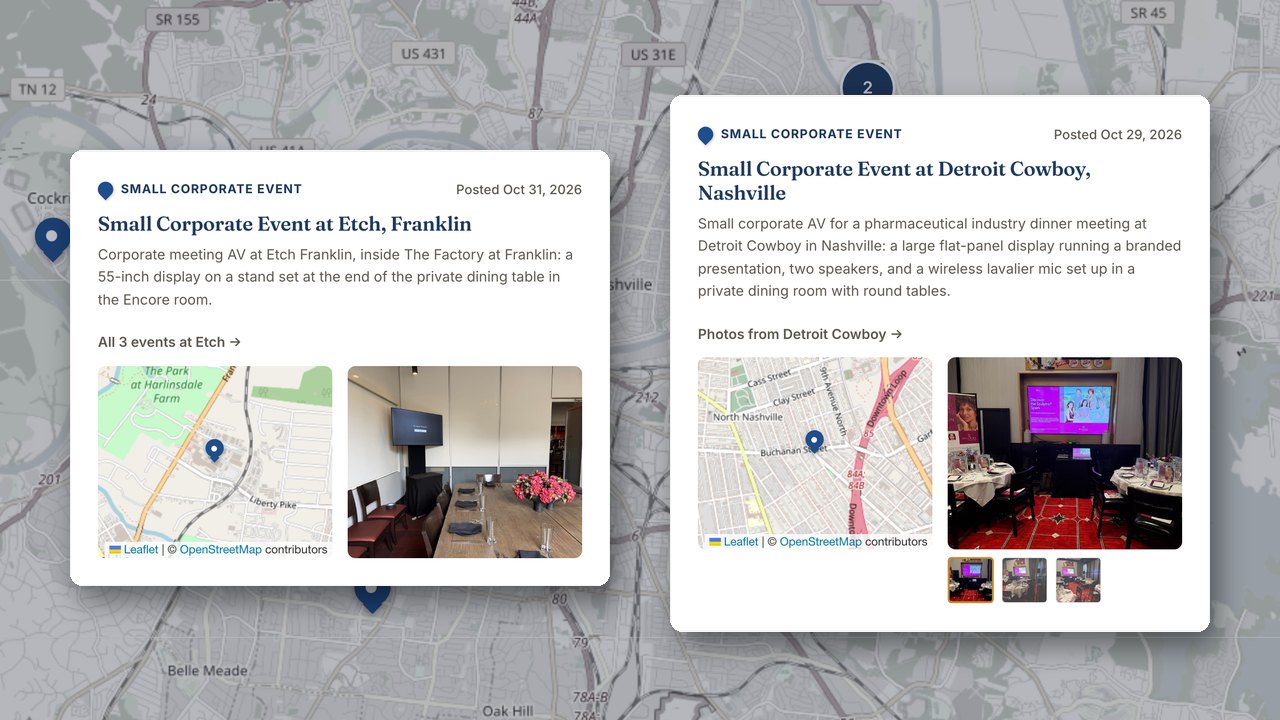
AmpLive is built to fill that half. The system includes a website, content planning and approval, blog and social publishing, newsletters, a CRM with quote intake, and GeoPins. GeoPins turns every finished gig into a pin on a real venue page. You name the venue and the type of event, never the client. Each venue page proves you have loaded in there. Planners search by venue, and AI assistants see real work tied to real places. You can see it working in the Nashville Visual story.
AmpLive is honest about its back-office status. Quotes, e-signature, deposits and payments are in build with Nashville Visual. Inventory with double-booking checks is on the roadmap. The platform page breaks down what is live today and what is on the roadmap. If your only problem is double-booked gear, a back-office tool is the right short-term fix. If your bigger problem is that the phone does not ring, the back-office tool will not answer it.
How to choose
Ask any software vendor the same questions. They cut through the demos fast.
- Does it get my bookings and my marketing into the same place?
- Is there an API or export?
- Who owns the data?
- Can it change when my process changes, and how fast?
- What is live today vs on the roadmap?
Notice that none of those questions asks for a feature list. They ask about fit, ownership and speed. A vendor that cannot answer them clearly is selling a product, not a system.
The bottom line
Goodshuffle Pro, TapGoods, Booqable and Rentman are useful back-office tools. They are not visibility engines. They do not get you onto the shortlist that AI assistants use. They do not prove your work at real venues. They do not make the phone ring.
If you want to see how AmpLive pairs the missing half with the back office, book a demo.